

A 10 year planning permission the construction of a solar PV energy development associated Battery Energy Storage System (BESS) facility with an operational life of 40 years on lands totalling approximately 36.3 hectares within the townlands of Kilbrew and Loughlinstown, Co. Meath. The development will consist of the installation of approximately 208,600 sq. m. of photovoltaic panels on ground mounted frames and associated ancillary development including 3 no. transformer stations, string-inverters attached to panel frames, 25 no. CCTV security cameras mounted on 4 metre high poles, deer-proof perimeter security fencing (2 metres high) raised 200mm to allow for the movement of small mammals and gates; a BESS facility comprising an electrical compound, 180 no. battery storage units, electrical transformer/inverter station modules, 45 no. transformers, 3 no. storage containers, 3 no. 33 kV switch gear rooms, 1 no. control room building, 1 no. water tank, 1 no. underground fire water containment tank, a surface water infiltration area and 7 no. CCTV cameras enclosed with 2.5 metre high security fencing; the creation of a new access on L50161 public road to facilitate construction and operational phase access; internal access tracks between the solar arrays and the site entrance; a temporary construction compound; and all ancillary development works including landscaping and underground cable to connect the proposed transformer stations to a proposed 110kv substation with electrical control building and associated compound the subject of a separate planning permission under the Planning and Development (Strategic Infrastructure) Act 2006.
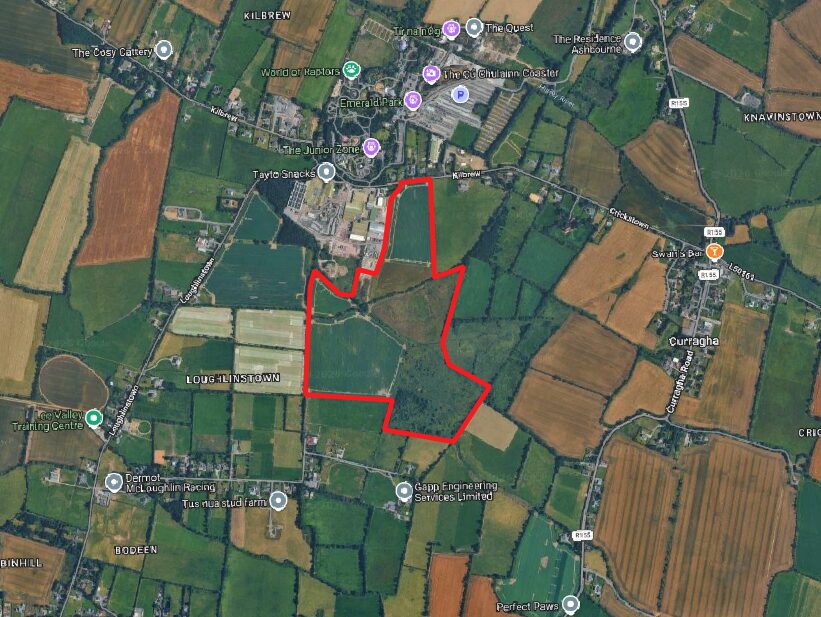
Project Sitemap
An overview map showing the project boundaries and key local roads for context.
Application Process
Environmental survey data was collected on-site and used to directly inform and guide the project design. The design of the proposed solar farm has been revised in response to feedback from Westmeath County Council and will be further refined for public submissions to ensure it aligns with the needs and concerns of the local community.
Supporting Information
A Planning and Environmental Considerations Report was prepared and submitted with the application. This includes:
- Population
- Biodiversity
- Water
- Noise
- Landscape and Visual
- Cultural Heritage
- Traffic and Transport
- AA Screening/Natura Impact Statement
A Glint and Glare Assessment, Landscape Management Plan and a Flood Risk Assessment was submitted as part of the planning application, along with a Construction Environmental Management Plan (which will be fully finalised before any construction work takes place).
At Hallstown Solar and BESS, our goal is to deliver clean, renewable energy while creating lasting benefits for the local community and environment. By listening, sharing updates, and engaging openly, we can ensure the solar farm reflects local priorities and provides real value for everyone.
Can the land be used for agriculture?
Yes. There is enough space below and around the panel arrays to enable grazing by small farm animals such as sheep.
Will the solar farm be noisy?
How long will it take to build the solar farm?
Construction typically takes 12 months.
Will there be an increase in traffic?
Will there be glint or glare from solar panels?
Will there be glint or glare from solar panels?
What security measures will there be?
Solar farm developments incorporate biodiversity areas, landscape buffers and new and enhanced hedgerow planting that provide habitats for a variety of wildlife such as birds, insects and mammals. Panel arrays provide shade and shelter and vegetation within the site nurtures the soil and attracts insects.
Will the solar farm help biodiversity?
What happens when the operation of the solar farm ends?
Will the value of my property be devalued?
What is a Battery Energy Storage System (BESS)?
A Battery Energy Storage System (BESS) stores electricity and supplies it back to the electricity grid when it is needed. It helps balance supply and demand and supports the reliable operation of the electricity network.
Why is a BESS project needed?
Why has this location been chosen?
Will there be an increase in traffic?
Is the BESS linked to a solar or wind farm?
What will the BESS site look like?
How big is a typical BESS site?
Will the BESS generate noise?
Will there be traffic impacts?
Is a BESS site staffed?
Is a BESS safe?
Is there a risk of fire?
Will emergency services be consulted?
Will the project affect the environment?
Will there be lighting at night?
How does the BESS connect to the grid?
Will new overhead power lines be required?
How long will the BESS operate?
What happens at the end of the project’s life?
Do I need to give feedback?
How can I make a comment or ask a question?
What is Community Benefit Fund
A Community Benefit Fund (CBF) is a government‑mandated fund linked to RESS (Renewable Electricity Support Scheme) solar projects. These funds provide long‑term financial support to communities located near renewable energy developments.
What is the purpose of CBF?
Every RESS‑supported solar project contributes to a CBF at a minimum rate of €2 per MWh of electricity generated. Because this contribution continues for 15 years, communities receive predictable, stable support throughout the operational life of the project.
How does CBF support communities?
How is CBF governed?
- Develops and delivers the project
- Appoints the Fund Administrator
- Reports annually on outcomes
- Oversees overall governance
- Supports the Fund Committee
- Develops the funding strategy
- Implements committee decisions
- Ensures governance compliance
- Provides volunteers for committees
- Submits funding applications
- Delivers approved local projects
- Benefits from funded activity
- Includes Developer, Administrator and Community representatives
- Sets funding goals and strategy
- Reviews and approves applications
- Operates under RESS governance
The proposed Hallstown Solar and BESS will benefit from ongoing participation by interested parties at every stage of development. If you would like to comment or request more information, please complete the contact form below. A member of our team will respond as soon as possible.
Call
Call us on +353 1 685 2858.
We’re around Monday to Friday,
9:00AM to 5:00PM
Email us directly at
info@powercapital.ie
Visit
86-88 Lower Leeson Street
Dublin 2, Ireland,D02 A668
How can we help? Let us know below and we’ll get back to you soon.